Thursday, June 21, 2007

Shudder

It is a little petrifying when right after this (where mention was made about a "value-vacuum"), one should read this (err ... don't judge a blogger by the url of his links) -

To assume the right to new values - that is the most terrifying assumption for a load-bearing and reverent spirit. To such a spirit it is preying, and the work of a beast of prey.
Nietzsche talks about how the spirit metamosphoses from camel to lion to child. One can see how this is the basis of his argument towards the Übermensch. But somehow I have this nagging feeling that both Nietzsche and Camus had a similar end in mind while propounding their respective philosophies -- an end where man lives "non-destructively", despite the realization that life is futile and meaningless.
With Nietzsche, my problem is with the child phase.
But tell me, my brothers, what the child can do, which even the lion could not do? Why must the preying lion still become a child? The child is innocence and forgetting, a new beginning, a game, a self-rolling wheel, a first movement, a sacred Yes. For the game of creation, my brothers, a sacred Yes is needed: the spirit now wills his own will; the world's outcast* now conquers his own world. [Emphasis mine]
Consider a spirit having shed its camel tendencies and adopted a lion form. Now what is more easier? Creation or destruction**?
Nietzsche outlines three stages towards attaining the Übermensch -
1. Destruction of already existing "weak" societal values.
2. Creation of new values (purportedly anti-nihilistic values).
3. Continuous improvement or self-overcoming, so as to repeat steps 1 and 2 above.
But then the problem with the idea of a Superman, in my opinion, is in step 2. What is to stop these values from becoming destructive? What justifies creation? Why is creation morally superior to destruction? Even Nietzsche argues for relativistic values i.e. one man's virtue is another man's vice, which is in fact the founding basis for a Superman. So it is not hard to imagine a Superman who seeks values contrary to those of Nietzsche's idea of Superman.
In other words, why not a destructive Superman?
Jesus F Christ.
Tyler Durden all over again.
* The outcast or he who is lost to the world. Very tempting here to draw parallels to Camus's The Outsider -- should the Meursaults of the world go on to become Supermen? Where Camus seems to advocate an indifference and apathy which is, to go out on a limb, characteristically French, Nietzsche is all for progress and creation, which, at the risk of generalization, sounds wonderfully German.
** On a moral plane. It all fits in now -- why Ayn Rand had to go out of her way to paint Ellsworth Toohey as a sissy, at least physically.

Tuesday, June 19, 2007

Filler

Since we are indulging in fillers until I get writing again, a poem from W. H. Auden. Yes, another all-time favourite.


*
The More Loving One
Looking up at the stars, I know quite well
That, for all they care, I can go to hell,
But on earth indifference is the least
We have to dread from man or beast.

How should we like it were stars to burn
With a passion for us we could not return?
If equal affection cannot be,
Let the more loving one be me.

Admirer as I think I am
Of stars that do not give a damn,
I cannot, now I see them, say
I missed one terribly all day.

Were all stars to disappear or die,
I should learn to look at an empty sky
And feel its total darkness sublime,
Though this might take me a little time.
*
UPDATE - Thought I'd put down some of my thoughts as to why I like this poem.
There is no breathtaking sweep about the poem and neither is there stunning imagery. The language is all the more conspicuous by its lack of disguise. No, this is a poem straight from the heart, without any gimmickry of the literal sort.
Auden asks us to keep our expectations at the door with the first two lines. No, he seems to say, it's a simple one this time, listen well, and oh, in case you didn't notice, I'm still rhyming*.
Indifference is nothing, Auden posits. What's more difficult is dealing with feelings of affection and admiration -- even love -- when the object of those feelings does not reciprocate in equal measure. Hence, the title. No, this is not about indifference. No, this is not about unrequited love. This is about distance. And pride. And that's where the reference to "stars" comes into the picture. Why "stars"? Why not something else? Auden perhaps wishes to tap into the notions of distance and exaltation that we commonly associate with stars. Perhaps the object of his affections is not distant in a physical sense but is more immediate and out of reach, out of his league maybe, and he can only stand and admire from afar.
I like the poem for the way Auden stands and reflects on this emotional precipice, threatening to plunge down into self-pity. In the end, he restrains himself nobly but for the two lines that mark the poem out - If equal affection cannot be / Let the more loving one be me. He gives in, acknowledges that he's the one at fault for seeking an "affection" that cannot be "equal" in the first line, and then in the very next line, redeems himself by asking permission (in a voice that would be quiet and soft I would imagine and without melodrama) for a subsidiary position, which in fact places him on a higher plain plane, morally and psychologically.
The rest of the poem is about how Auden, having voluntarily relegated his feelings, sustains his pride despite the blow to his self-esteem that such an acknowledgement would obviously deal have dealt. He says how, despite admiring his stars, he cannot bring himself to "say / I missed one terribly all day." There is something about the words he uses -- "go to hell" and "don't give a damn" -- which gives us a clue about the true nature of these stars of his and where he stands with them. We've all been there, where ego takes over and seeks to heal the wounds of the heart. How we don't say what we should lest we appear "clingy". Confessions are to be private and even then only within the closed confines of one's conscience. Communication of such confessions to the object of one's affection (especially when they "don't give a damn") are not to be engaged in, lest the self injures itself further. No, one can't afford to appear needy. It is beneath one's dignity, despite what one feels otherwise. That seems to be Auden's stance.
Finally, Auden seems to conjecture - what would happen if the stars were to "disappear or die" and concludes that even if it takes "a little time", he would "learn to look at an empty sky / And feel its total darkness sublime". That, all said and done, all affection is ephemeral -- stars do die, for whatever reasons -- and we have to live with our selves, even if it takes time and patience, and that solitude sometimes is neither refuge nor escape but the only way to live in a complicated world.
Brilliant pithy poem. Shows how an emotion should be carefully examined and nurtured into words.
* - A friend once told me that he looked down upon poems which rhymed. In his opinion, a rhyme scheme always forced the poet to settle for effect rather than concentrate on meaning. Of course, he liked free verse. But I wish he would read Auden. If not for anything, for the effortless ease with which Auden rhymes and makes it sound all so natural, without compromising on the content.

Monday, June 18, 2007

P & C - 2

Calvin - So this Radha girl ...

Partha - Yeah?

Calvin - You have feelings for her?

Partha - Hmmm ... maybe.

Calvin - That a yes or a no?

Partha - Actually, NO! Why don't you go update that blog of yours? Idiot.

Calvin - Who you kidding huh? I've seen how you shape around her, playing Pink Floyd on your flute.

Partha - Argh! I don't "shape" around her. What's wrong with you? And it's kambakth ishq, by the way, not Pink Floyd.

Calvin - Whatever. She's kinda cute though ...

Partha - Hmmm.

Calvin - What do you think?

Partha - Why do you ask me? How should I know? Somebody's left a comment on your blog. Go check.

Calvin - But you know what they say ...

Partha - What?

Calvin - [with an evil grin] Get to first base before you think of a home run.

Calvin - Par rehta hai jab tak yeh kambakth jannat dikhaata hai ...

***

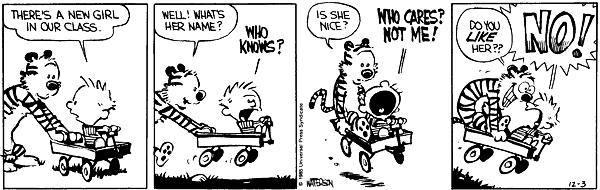
The strip that's linked to is an all-time favourite. The more I read it, the more I admire Watterson's genius. The way he slowly builds up Calvin's irritation (and equally, Hobbes' curiosity) using the wheelbarrow's momentum as a metaphor reeks of class. And the look on Hobbes' face in the final panel is absolutely priceless. To appreciate the idea, think of the same strip with the two walking at a slow pace, like they do in the more philosophical strips.
UPDATE: A friend writes in to say that "Partha" is not you-know-who. All I can do is smile knowingly in my eternal wisdom and say simply, "Postmodern".